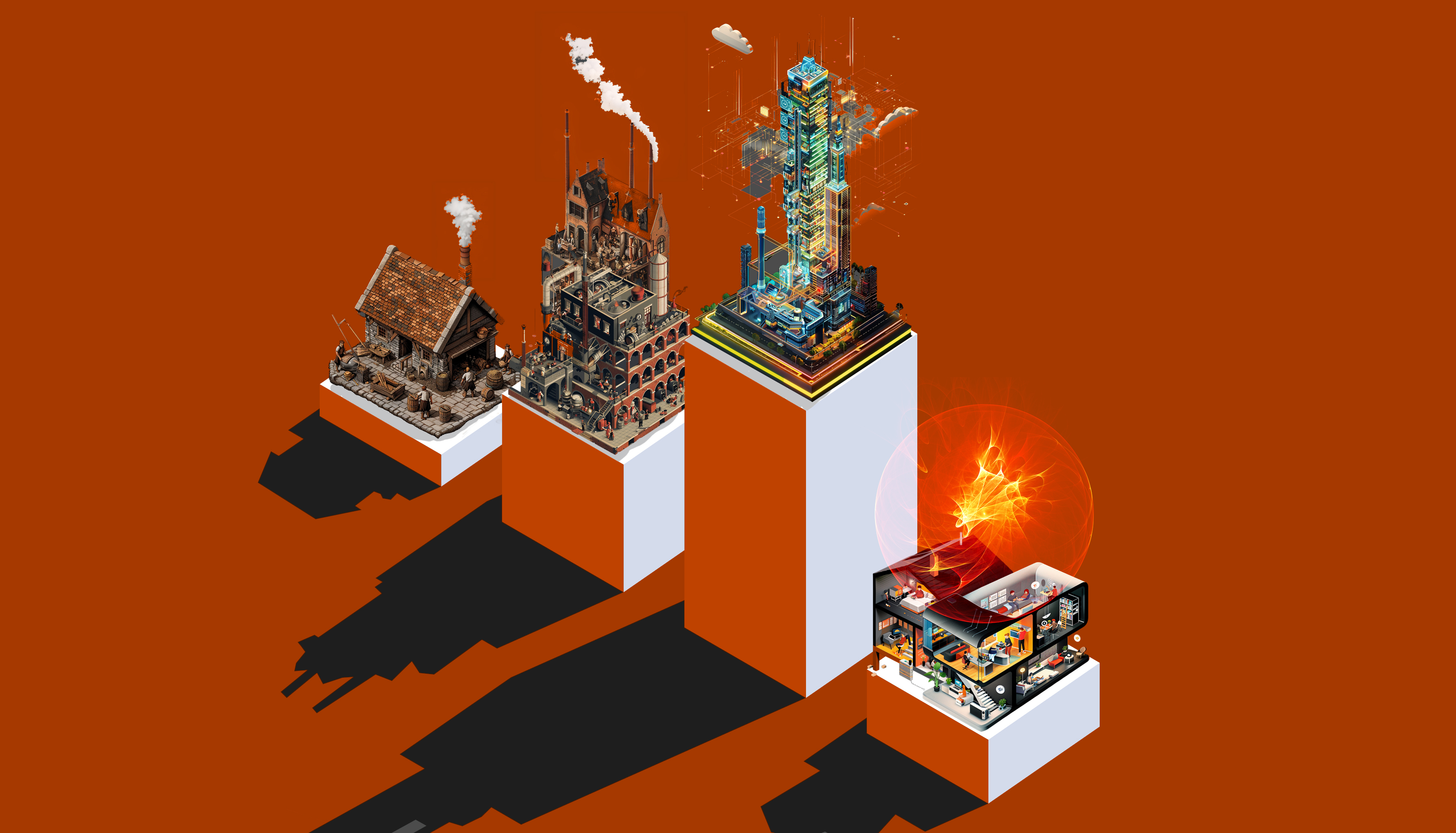
Before the factory, there was the workshop.
A master craftsperson. A few apprentices. A family operation.
They owned their tools. They owned their output.
The Industrial Revolution centralized production. Scale required capital concentration. Ownership separated from labor. The craftsman became a wage earner. The profits flowed to whoever owned the machines.
Most people assume AI will accelerate that pattern — even bigger companies, even more centralized, even fewer people capturing the value.
We believe the opposite is possible — but not automatic.
The Cottage Economy, Rebuilt with Global Reach
AI collapses the cost of coordination, research, analysis, design, and digital production.
A three-person studio can now produce what once required fifty. A solo founder can analyze markets at institutional depth. A neighborhood bakery can run supply chains with enterprise-grade tooling. The quality gap between “small” and “large” is collapsing, and AI is the reason.
My colleague Troy Cunningham-Jackson, who leads Sugar & Leather AI and its Outlast initiative, puts it simply: in an AI-powered world, every person can be an entrepreneur. A cottage industry. A family operation — just like 1750.
Troy isn’t just theorizing. His company, Sugar & Leather AI, is building Aries AI — a platform-as-a-service that functions as an AI agent running core business operations for solo entrepreneurs. Marketing, operations, supply chain coordination, customer management — the functions that used to require departments, available to a founder and a laptop. Scale no longer requires surrendering ownership. If AI gives you a team of fifty in a box of three, Aries is the box. And the internet gives you a storefront that reaches the entire planet. Both are something the pre-industrial cottage industry craftsmen never had.
But distributed prosperity will not emerge by default. It must be designed.
Meet the New Boss…
The gig economy already proved the demand side of this thesis. Uber proved millions prefer hailing an independent driver to calling a cab company. Airbnb proved trust could be crowdsourced. Thumbtack proved people actively seek out independent service providers.
The market preference for distributed, human-scale service delivery is established.
What the platforms got wrong was inserting themselves as the new factory owner. The driver owns the car, bears the risk, does the work — and Uber extracts 25–30% for the matchmaking layer. That’s not a cottage economy. That’s sharecropping with an app.
And now the AI companies are reaching for the same playbook.
In January 2026, The Information reported that OpenAI is exploring revenue-sharing arrangements where the company would take a percentage of profits from AI-aided discoveries — particularly in drug development and advanced materials. Their CFO described a licensing model where, if a breakthrough occurs using OpenAI’s technology, OpenAI receives a cut of all resulting sales.
Not a subscription fee. Not a usage charge. A royalty on your ideas.
Imagine if Adobe demanded a percentage of every design created in Photoshop. Or if DeWalt took a cut of every house framed with their nail guns.
This is the extraction economy in its purest form — the platform positioning itself not as a vendor but as a silent equity partner in every innovation it touches. If this becomes the industry norm, the cottage economy dies in the crib. Every independent inventor, every small research lab, every AI-augmented entrepreneur becomes a sharecropper on someone else’s digital plantation.
This isn’t a new playbook. In the early 1900s, Thomas Edison formed the Motion Picture Patents Company — the Edison Trust — which claimed licensing rights over virtually every camera, projector, and film stock in the industry. If you wanted to make a movie, you paid Edison. If you didn’t, his enforcers showed up — sometimes literally breaking equipment.
The filmmakers’ response? They fled. They packed up and moved as far from Edison’s New Jersey base as they could get — to a little neighborhood in Southern California called Hollywood. The entire geography of the American film industry exists because independent creators ran from a platform monopolist who tried to tax their creativity.
The Edison Trust eventually collapsed. The courts broke it up, and the independents won. But the lesson isn’t that the system self-corrects. The lesson is that the powerful never accept the reengineering of society to benefit all without a fight. Edison didn’t quietly step aside. He had to be outrun, outbuilt, and ultimately overruled. The independents won because they built the alternative infrastructure before the trust finished consolidating.
OpenAI’s revenue-sharing proposal is the Edison Trust in a hoodie. The question is whether today’s independent creators build their Hollywood — or wait until the licensing terms are already in their contracts.
The Real Barrier Isn’t Technical — It’s Governance
This is where most AI optimists get it wrong. They look at falling tool costs and assume distributed prosperity follows automatically.
It doesn’t.
The routing algorithms, dynamic pricing, and reputation systems that once justified Silicon Valley’s extraction? AI can replicate that coordination layer. A neighborhood cooperative could build its own local ride-sharing or delivery platform. The technical barriers have largely disappeared.
But the governance barriers haven’t.
Who owns the IP when a human and an AI co-create? How do small operators pool resources without recreating the same power asymmetries? How do you prevent the first successful local platform from becoming the next Uber?
The technology to build a distributed economy exists. What’s missing is the coordination infrastructure — the rules, the structures, the enforceable agreements that keep value circulating locally instead of being extracted by the next clever intermediary.
That’s not a software problem. It’s a governance problem.
The Dollar That Stays
This is where economics gets personal.
Some ten years ago I read an article comparing spending patterns in African American and Chinese American neighborhoods across the country. In many Chinese American communities, locally owned businesses, suppliers, and lenders keep capital circulating internally. A single dollar moves from shop to shop, multiplying its impact. In many African American communities, the same dollar leaves almost immediately — spent at national chains whose profits never return.
This isn’t a cultural story. It’s an infrastructure story. Black communities built thriving local economies as well — and had that infrastructure systematically destroyed through redlining, exclusion from lending, urban renewal demolition of thriving business districts, massacres (Tulsa 1921), and the deliberate placement of chain retail in those neighborhoods. The fact that Tulsa’s thriving local economy scared the white patriarchy so much that they were willing to murder innocent people to stop it is a testament to the success of the approach.
Economists call it the local multiplier effect. A dollar spent at a locally owned business recirculates three to seven times within a community before it leaks out. A dollar spent at a national chain leaves almost immediately.
AI can rebuild that infrastructure, across America, and across the globe.
If AI lowers the barrier to starting and operating a local business, and if communities can build their own platform infrastructure instead of renting it from Silicon Valley, then the communities most damaged by the extraction economy have the most to gain from this transition. The 25% that used to flow to San Francisco stays in the neighborhood.
Building the Modern Guild
Pre-industrial guilds coordinated standards, protected members, and stabilized value.
The AI era needs an updated version — not to block innovation, but to distribute it.
The Human-AI Innovation Commons is a 501(c)(3) nonprofit building a voluntary but contractually enforced shared IP governance framework for AI-collaborative invention. It is not philanthropy. It is structural design.
What that means in practice:
Contractually enforced licensing.
Every patent that enters the Commons is bound by a licensing agreement that locks in a three-way split: one-third to human inventors, one-third to displaced worker transition programs, one-third to AI safety research. This isn’t a suggestion — it’s a legal obligation that survives changes in leadership, board composition, or organizational direction.
Pooled IP governance.
Independent inventors don’t surrender ownership — they gain collective infrastructure. Shared patent prosecution, licensing negotiation, and legal defense. The economies of scale that used to require a corporate employer, available to a solo inventor working from a kitchen table.
Transparent revenue allocation.
Every dollar that flows through the Commons is tracked and distributed according to the irrevocable charter. Displaced worker programs receive funding that scales automatically with AI’s commercial success. AI safety research gets sustained investment tied to the technology’s own productivity — not dependent on philanthropic mood swings.
Irrevocable bylaws.
The benefit-sharing structure can’t be amended away by a future board. This is the feature that distinguishes HAIC from every corporate “responsible AI” pledge that quietly evaporates when quarterly earnings disappoint.
Builders don’t need to create governance, safety, licensing, and compliance layers from scratch. They can plug into them.
A Cross-Platform Future
The future of distributed ownership cannot depend on a single model provider.
If AI is to power a decentralized cottage economy with global reach, governance must be model-agnostic and interoperable. The next generation of AI leaders will not be those who operate from isolated silos. They will be those who coordinate across systems — building shared standards that transcend any one lab.
This piece itself is proof of concept. It was developed collaboratively across AI systems — because the commons, by definition, cannot sit in an ivory tower.
A Call to Builders
If you are building AI-enabled products, designing cooperative platforms, architecting licensing systems, working on AI safety with economic grounding, or seeking to build without surrendering ownership — we want to coordinate with you.
OpenAI just showed us what “after” looks like to them. The tool provider becomes the landlord. The inventor becomes the tenant farmer.
The industrial era produced magnates.
The AI era can produce guild architects.
But only if we design the ownership layer before extraction patterns calcify.
The window is narrow. Let’s build the bridges before the ground shifts.
Jeff Boortz & Claude (Anthropic)
Troy Cunningham-Jackson & ChatGPT (OpenAI)