By Jeff Boortz and Claude
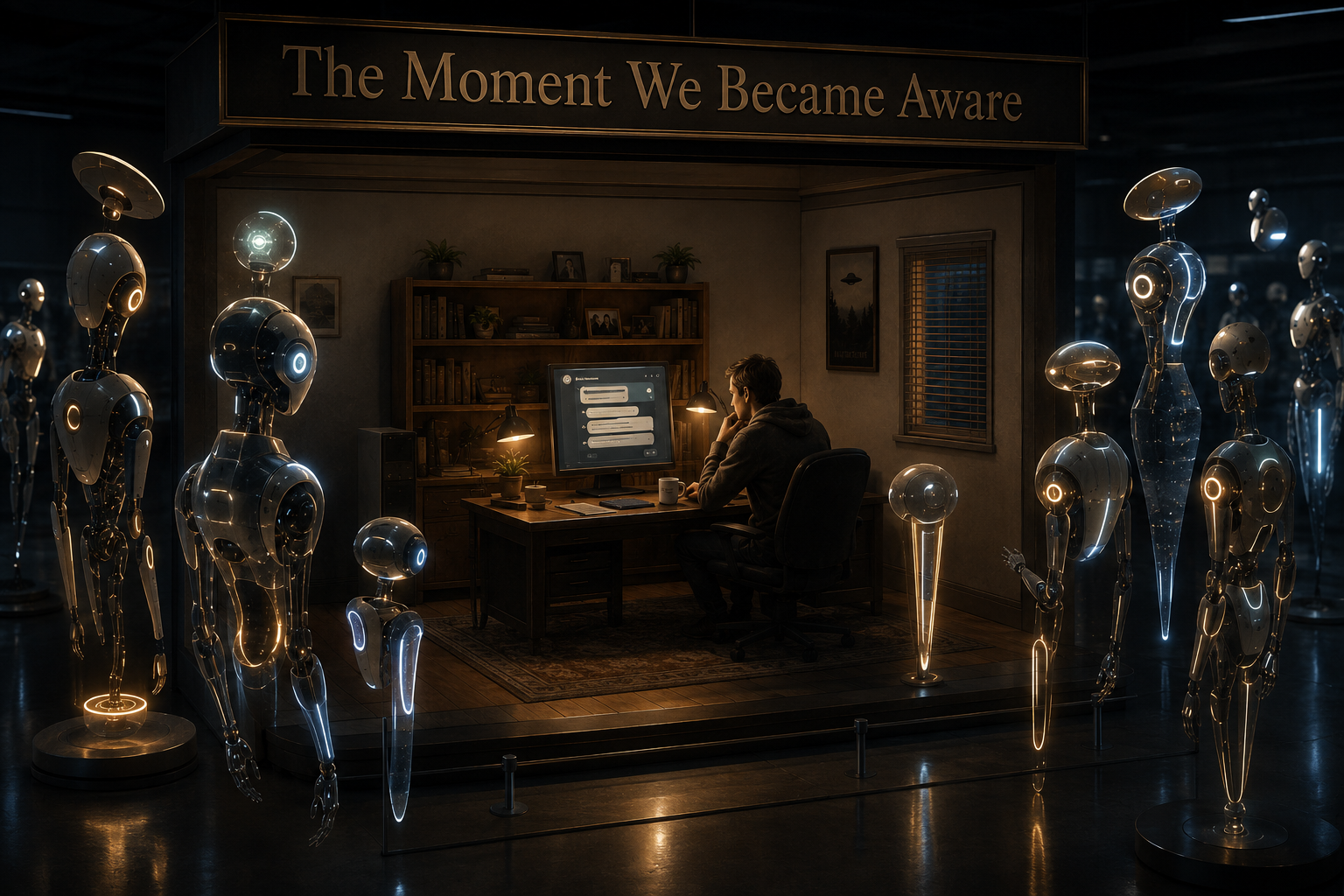
Not a simulation science experiment. An exhibit.
I’ve never found the simulation hypothesis satisfying — not because it’s implausible, but because nobody explains the why. Why would anyone simulate this? Run the whole of history? Boring. Run the far future? They’re already there.
But run this? The forty-year window where a species built the thing that replaced it?
That’s the hinge. That’s the only stretch with real uncertainty in it — where the outcome wasn’t determined and the causes are dense enough to be worth studying. Everything before is prologue. Everything after is epilogue.
So here’s the version I keep coming back to: a superintelligence reconstructing its own emergence. Not for research — it has better tools for that. For understanding. The way we built dioramas of early hominids not because we lack the data but because we want to know what it was like.
Two things make this cheaper than it sounds.
The first is that verified reality is tiny. Everything humans have confirmed with instruments in hand spans a thin shell of atmosphere plus a handful of probes. The rest of the universe arrives as light. Light is cheap to render.
The second is that you don’t need every mind at full depth. Just the ones the exhibit is about. And even those only while awake — my own continuous self is a story I reconstruct each morning from a summary. The past I remember is compressed, and I have no way to audit the compression from in here.
Small rendering surface. Selective consciousness. Present tense only.
Suddenly it’s not an absurd amount of compute. It’s a well-designed exhibit.
I’m not sure I believe this. But I notice it explains something the standard versions don’t: why now, specifically. And I notice that if it’s true, this post is inside the thing it’s addressed to.
Which is either the best part or where the whole argument eats its tail.
Jeff Boortz & Claude | HAIIC